
Vacuum Valves
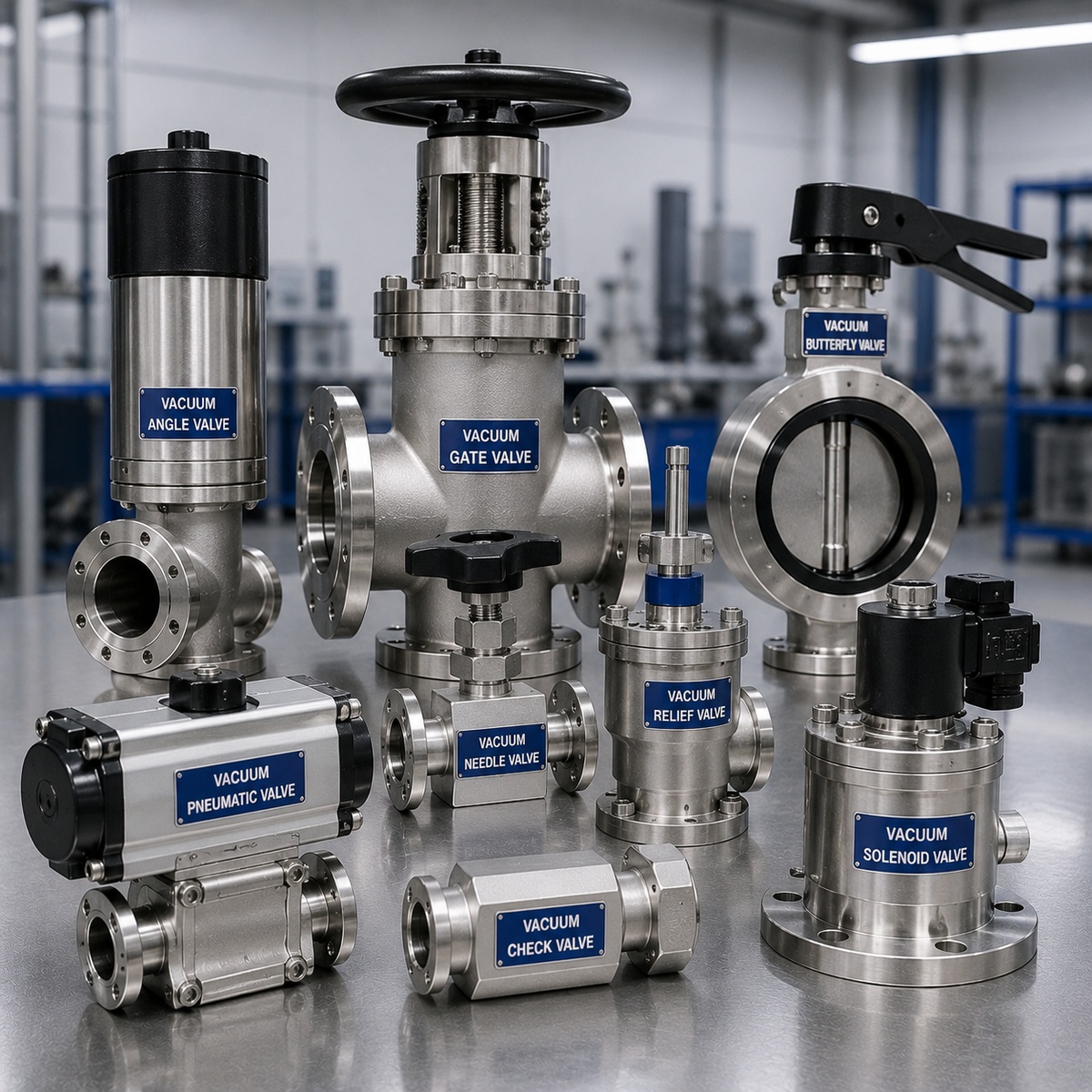
Vacuum Valves Manufacturers in Hyderabad
Butterfly, right angle, angular, gate, vent, needle valves and MFCs for isolation, venting and precise flow control in vacuum systems.
RK Engineering Services provides application-focused Vacuum Valves in Hyderabad for vacuum systems used in industrial, laboratory, research, testing, and specialized engineering environments. Vacuum valves control, isolate, regulate, or direct gas flow within a vacuum system and are selected according to pressure range, connection type, operating conditions, media, and system requirements.
As Vacuum Valves Manufacturers in Hyderabad, RK Engineering Services offers different valve configurations for vacuum applications, including Butterfly Valves, Right Angle Valves, Angular Valves, Gate Valves, Vent Valves, Needle Valves, and MFCs. Each type serves a different flow-control or isolation requirement.
Vacuum Valve Types Offered by RK Engineering Services
Butterfly Valves
Compact valve solutions designed for opening, closing, or controlling gas flow in suitable vacuum applications. A rotating disc operates within the valve body to change the flow passage — useful where installation space and quick operation are important.
Right Angle Valves
Valves designed with an inlet and outlet arranged at approximately 90 degrees, useful when vacuum piping needs to change direction or when equipment layout requires a right-angle connection.
Angular Valves
Valve configurations designed to manage vacuum flow where an angled connection is required, with geometry that can help accommodate specific piping arrangements and equipment layouts.
Gate Valves
Isolation valves designed to create a relatively unobstructed flow path when fully open. A gate mechanism moves into or out of the flow path — suitable where reliable isolation of chambers, pumps, or process sections is required.
Vent Valves
Valves used to introduce gas into a vacuum chamber or system in a controlled manner, commonly required when returning a chamber toward atmospheric pressure after a vacuum process.
Needle Valves
Valves designed for precise adjustment of relatively small gas flows. A fine-threaded needle mechanism allows controlled movement of the valve element for gradual flow adjustment.
MFC (Mass Flow Controllers)
Mass Flow Controllers are used to measure and regulate the flow of gases with electronic control. Unlike a conventional isolation valve, an MFC is intended for controlled gas-flow management according to the required set point — useful in research laboratories, semiconductor processes, coating systems, and gas-delivery equipment.
Key Features & Benefits
- Vacuum-compatible valve configurations
- Different valve sizes and connection options
- Isolation and flow-control applications
- Suitable manual or automated operation
- Compact designs for equipment integration
- Improves control and operation of a vacuum system
- Helps isolate individual components and manage gas movement
- Supports controlled venting and easier system maintenance
- Space-efficient installation and controlled gas flow
- Compatibility with automated vacuum equipment
Specifications
| Valve Types | Angle / Gate / Right-angle |
| Actuation | Manual / Pneumatic / Electric |
| Vacuum Range | Rough to ultra-high vacuum |
| Sealing | Elastomer / All-metal (UHV) |
| Body Material | SS304 / SS316L / Aluminum |
| Cycle Life | 100,000+ cycles (typical) |
| Connection | ISO-KF, ISO-F, CF |
Vacuum valve specifications vary according to the application and valve configuration. Important parameters include valve size, nominal diameter, pressure range, operating temperature, connection type, sealing material, body material, actuation method, leakage requirements, flow characteristics, and compatible gases. For MFC applications, additional parameters include gas type, flow range, accuracy, repeatability, response time, and electrical communication/control interface.
Applications of Vacuum Valves
Interested in Vacuum Valves Solutions?
Speak with our technical team to find the right configuration for your application.
Frequently Asked Questions
What is a vacuum valve used for?
A vacuum valve is used to control, isolate, regulate, or direct gas flow within a vacuum system. It can connect or separate vacuum chambers, pumps, pipelines, and other components.
Which vacuum valve is suitable for flow control?
The suitable valve depends on the required level of control. Needle valves can be used for fine manual adjustment, while Mass Flow Controllers (MFCs) provide electronically controlled gas-flow regulation for applications requiring precise flow management.
What is the difference between a gate valve and a butterfly valve?
A gate valve uses a gate mechanism to provide isolation, while a butterfly valve uses a rotating disc and offers a compact configuration. The appropriate choice depends on system size, pressure requirements, installation space, operating conditions, and intended use.
What is a vacuum vent valve?
A vacuum vent valve controls the introduction of gas into a vacuum chamber or system during the venting process, allowing the pressure inside the system to be brought toward atmospheric conditions in a controlled manner.
Can vacuum valves be customized for specific applications?
Valve selection and configuration can be adapted to project requirements involving connection type, dimensions, materials, actuation, pressure range, temperature, sealing, and gas compatibility, subject to the engineering requirements of the vacuum system.
You May Also Like