Vacuum Coating Unit
Vacuum Coating Unit Manufacturers in Hyderabad
Thermal evaporation, E-beam and sputtering coating systems with materials, targets, monitors and power supplies for thin-film deposition.
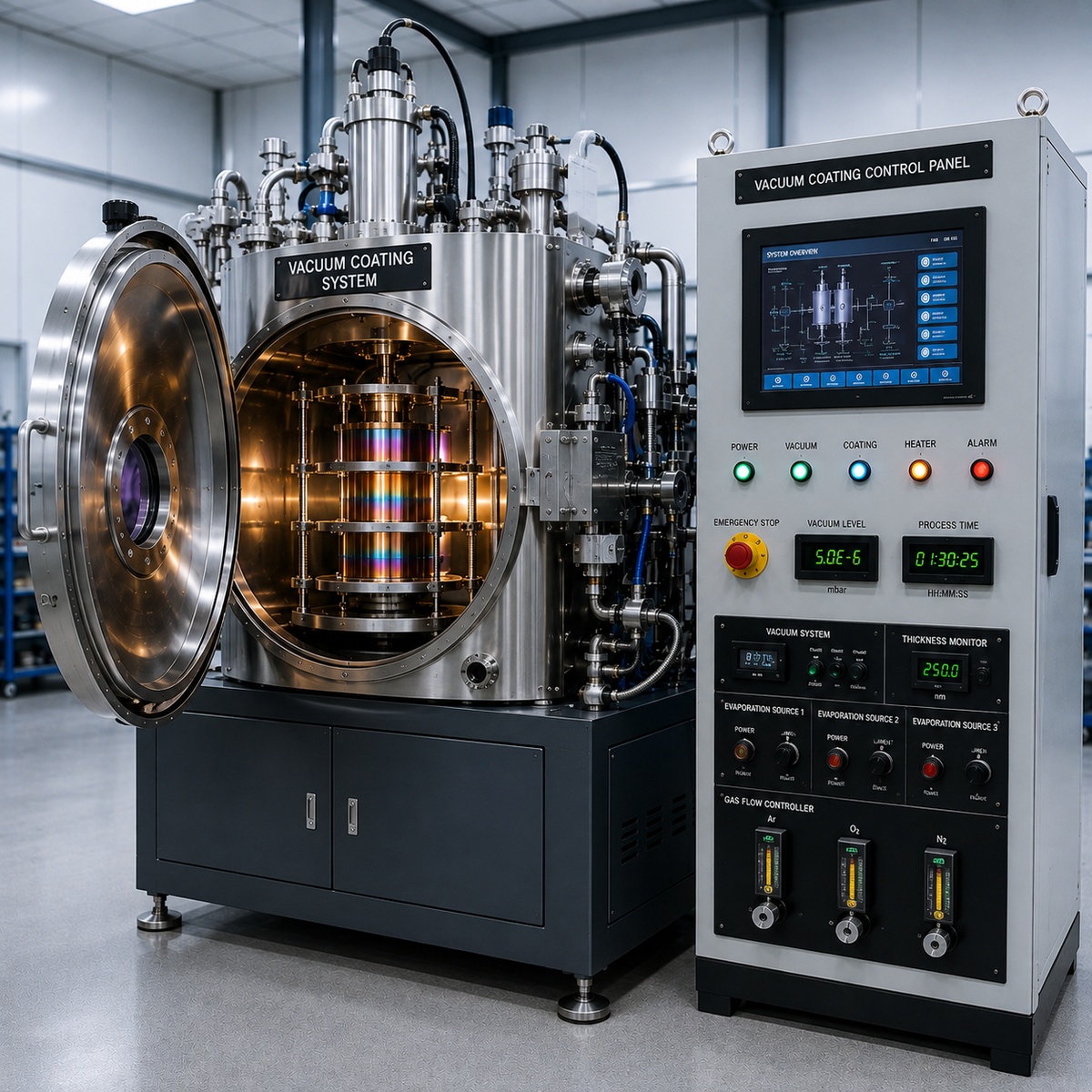
Vacuum coating units are advanced industrial systems used to deposit thin, uniform layers of metals, alloys, oxides, and other functional materials onto different substrates under controlled vacuum conditions. As Vacuum Coating Unit Manufacturers in Hyderabad, manufacturers and suppliers provide customized coating solutions for industries such as electronics, optics, automotive, packaging, decorative products, solar components, research laboratories, and precision engineering.
A modern vacuum coating machine in Hyderabad can be configured according to coating material, substrate size, coating thickness, production volume, and required deposition technology. These systems are designed to provide controlled vacuum levels, consistent deposition rates, uniform coating, and repeatable production performance.
Depending on the application, customers can select thermal evaporation systems, E beam systems, sputtering systems, coating materials, sputtering targets, quartz crystals, thickness monitors & controllers, liners, evaporation boats/baskets, evaporation filaments, power supplies, and vacuum metalising units.
What Are Vacuum Coating Units?
A vacuum coating unit is a specialized equipment system that creates a controlled low-pressure environment to deposit a thin coating onto a substrate. Removing air and contaminants from the chamber allows coating materials to evaporate or sputter and form a controlled layer on the target surface. Vacuum coating machines in Hyderabad are available in different configurations, ranging from laboratory-scale coating equipment to industrial production systems.
Major Vacuum Coating Technologies
Thermal Evaporation Systems
Thermal evaporation systems heat a coating material inside a vacuum chamber until it evaporates. The vapor travels through the vacuum environment and condenses onto the substrate. These systems are suitable for depositing materials such as aluminum, silver, gold, and other compatible materials.
E Beam Systems
E beam systems use a focused electron beam to heat and evaporate coating materials. Electron-beam evaporation can provide precise control and is suitable for materials requiring high evaporation temperatures.
Sputtering Systems
Sputtering systems use plasma to eject atoms from a target material and deposit them onto a substrate. They are commonly used where controlled thin-film deposition, adhesion, and material flexibility are important.
Coating Materials & Sputtering Targets
Vacuum coating processes can use a wide range of coating materials depending on the application, including metals, alloys, oxides, and other specialized deposition materials. Sputtering targets are source materials used in sputtering systems — target composition, purity, dimensions, and compatibility with the coating process can be selected according to application requirements.
Features and Benefits of Vacuum Coating Units
Key Features
- Controlled Vacuum Environment: Chambers designed to achieve the pressure conditions required for stable deposition.
- Uniform Coating: Proper substrate arrangement and deposition control for consistent thickness.
- Process Automation: Automated controls for vacuum generation, deposition and monitoring.
- Thickness Monitoring: Integrated equipment to measure and control deposited film thickness.
- Custom Chamber Configuration: Dimensions and internal arrangements adapted to application requirements.
- Safety Features: Interlocks and protective mechanisms to help reduce operational risks.
Important Supporting Components
- Quartz Crystals: Used with crystal-based thickness monitoring systems.
- Thickness Monitors & Controllers: Real-time deposition rate and coating thickness information.
- Liners: Contain or support coating materials inside evaporation sources.
- Evaporation Boats/Baskets/Filaments: Hold and heat coating materials during thermal evaporation.
- Power Supplies: Controlled electrical energy for evaporation sources, sputtering systems and heaters.
- Vacuum Metalising Units: Depositing metallic films for decorative, reflective and packaging applications.
Specifications
| Chamber Size | 300 – 1500 mm (custom available) |
| Ultimate Vacuum | 1 x 10⁻⁵ mbar |
| Deposition Method | Thermal / E-beam / Sputtering |
| Substrate Rotation | Planetary / Single-axis |
| Control | PLC / HMI touchscreen |
| Power Supply | 3-phase, 415V |
| Cycle Time | Process dependent |
Applications of Vacuum Coating Machines
Thin-film applications for electronic components and specialized substrates.
Controlled surface films for optical components.
Decorative and functional coating of selected components.
Metallic finishes and functional layers on compatible substrates.
Metallic or colored surface finishes on plastic, glass, and metal products.
Selected thin-film and functional-layer manufacturing processes.
For businesses comparing vacuum coating unit manufacturers and suppliers in Hyderabad, it is important to match the equipment configuration with the actual deposition process rather than selecting a machine based only on chamber size or production capacity.
Interested in Vacuum Coating Unit Solutions?
Speak with our technical team to find the right configuration for your application.
Frequently Asked Questions
What is a vacuum coating unit?
A vacuum coating unit is equipment used to deposit a thin layer of material onto a substrate inside a controlled vacuum chamber. Depending on the system, deposition can be performed using thermal evaporation, electron-beam evaporation, or sputtering technology.
What are the main types of vacuum coating systems?
The main types include thermal evaporation systems, E beam systems, and sputtering systems. Thermal evaporation uses heat to vaporize compatible materials, E beam systems use an electron beam for evaporation, and sputtering systems use plasma to deposit material from a target onto the substrate.
What components are used in a vacuum coating system?
Important components can include a vacuum chamber, vacuum pumps, deposition sources, power supplies, coating materials, sputtering targets, quartz crystals, thickness monitors & controllers, liners, evaporation boats/baskets, and evaporation filaments. The exact configuration depends on the coating process.
How is coating thickness controlled?
Coating thickness can be monitored using quartz crystal-based thickness monitoring equipment. Thickness monitors & controllers can provide information about deposition rate and accumulated film thickness, allowing operators to control the deposition process according to the required specifications.
How do I select vacuum coating unit manufacturers in Hyderabad?
Consider the required coating technology, substrate size, coating materials, chamber capacity, vacuum requirements, deposition rate, thickness-control system, automation, maintenance requirements, customization options, and technical support.
You May Also Like