Vacuum Pump Manufacturers in India
Vacuum pumps play an important role in industrial manufacturing, scientific research, pharmaceutical production, food processing, chemical industries, and many other applications. These machines remove gas molecules from an enclosed space to create a pressure lower than atmospheric pressure. By maintaining the required vacuum level, they help improve process efficiency, product quality, and operational consistency.
Businesses searching for Vacuum Pump Manufacturers in India need to consider equipment performance, vacuum capacity, operating pressure, energy efficiency, maintenance requirements, and suitability for their specific industrial applications. Selecting the right vacuum pump can help industries achieve reliable production, reduce downtime, and maintain consistent operating conditions.
RK Engineering Services focuses on industrial engineering solutions and vacuum equipment requirements. When evaluating vacuum pump options, industrial buyers should understand the different technologies available, including rotary vane vacuum pumps, Roots pumps, diffusion pumps, dry vacuum pumps, and turbo molecular pumps. Each technology serves different pressure ranges and operating requirements.
This guide explains how vacuum pumps work, which industries use them, the main types available, and what businesses should consider when choosing a suitable vacuum solution in India.
What Is a Vacuum Pump and How Does It Work?
A vacuum pump is a mechanical or molecular pumping device designed to remove gases and vapours from a sealed chamber, pipeline, or industrial system. Its primary purpose is to reduce pressure and maintain the vacuum conditions required for a particular process.
Vacuum pumps operate through different mechanisms depending on their design. Some capture and transport gas using moving mechanical components, while others transfer momentum to gas molecules or use diffusion-based techniques.
The basic working process involves the following steps:
-
Gas Removal: The pump extracts air, vapour, or other gases from the connected system.
-
Pressure Reduction: Removing gas molecules lowers the pressure inside the chamber.
-
Vacuum Maintenance: The pump continues operating to maintain the required pressure level.
-
Process Support: The resulting vacuum enables manufacturing, drying, filtration, degassing, coating, or other industrial operations.
The appropriate pump depends on the required ultimate pressure, gas composition, pumping speed, chamber size, operating temperature, and process conditions.
Why Choose the Right Vacuum Pump Manufacturer in India?
Choosing a suitable vacuum pump supplier or manufacturer is important for industries that require dependable equipment and consistent performance. Different applications demand different vacuum levels, materials, sealing arrangements, and pumping capacities. When evaluating vacuum pump manufacturers in India, industrial buyers should consider the following factors.
-
Application-specific solutions: Equipment should match the requirements of the intended process.
-
Vacuum performance: The pump must achieve the required pressure and pumping speed.
-
Energy efficiency: Efficient operation can help control electricity consumption and running costs.
-
Material compatibility: Wetted components and seals should withstand the gases, vapours, and chemicals involved.
-
Maintenance requirements: Spare parts availability and serviceability can influence equipment uptime.
-
Technical support: Assistance with installation, commissioning, troubleshooting, and maintenance can simplify operation.
-
Total ownership cost: Buyers should consider the initial investment, energy use, consumables, servicing, and expected service life.
RK Engineering Services can be considered when exploring industrial engineering and vacuum equipment requirements. Buyers should confirm the specific pump models, technical capabilities, service coverage, and supply arrangements directly with the company before making a purchasing decision.
What Are the Different Types of Vacuum Pumps Available in India?
Vacuum pumps are classified according to their operating mechanisms, pressure ranges, and intended applications. The following technologies are important for industrial and specialised vacuum systems.
1. Rotary Vane Vacuum Pumps
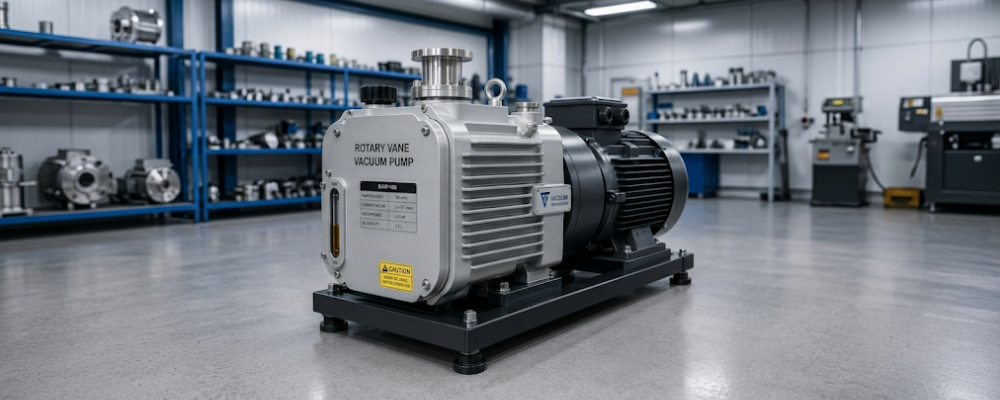
Rotary vane vacuum pumps are positive-displacement pumps commonly used in industrial applications that require dependable vacuum generation. They typically contain a rotor positioned eccentrically inside a cylindrical housing, with sliding vanes that form chambers of changing volume.
As the rotor turns, gas enters the expanding chamber, becomes trapped, and is compressed before being discharged. Oil-sealed versions use oil for lubrication, sealing, and heat removal, while dry-running designs operate without sealing oil in the pumping chamber.
Key features of rotary vane vacuum pumps:
-
Compact construction for many industrial installations.
-
Consistent pumping performance within the specified operating range.
-
Availability in different capacities and configurations.
-
Suitability for many rough- and medium-vacuum applications.
-
Straightforward maintenance when supported by suitable service procedures.
Common applications include:
-
Vacuum packaging and sealing machines.
-
Laboratory vacuum systems.
-
Medical and analytical equipment.
-
Vacuum drying and degassing.
-
Printing, woodworking, and material-handling equipment.
-
Industrial vacuum fixtures and process machinery.
Oil-sealed models may require oil changes, filter replacement, and monitoring for oil contamination. Dry-running versions can be preferable where oil-free operation is important, provided the design meets the application's requirements.
2. Roots Pumps
Roots pumps, also called Roots-type booster pumps, use two synchronised lobed rotors that rotate in opposite directions without normally contacting each other. Their movement transports gas from the inlet to the outlet, increasing the overall pumping capacity of a vacuum system.
Roots pumps are frequently used as booster pumps alongside a suitable backing pump. They can improve pumping speed over selected pressure ranges, making them useful for applications requiring faster evacuation of large chambers or process equipment.
Advantages of Roots vacuum pumps include:
-
High pumping speed over their designed operating range.
-
Ability to improve evacuation performance when paired with a backing pump.
-
Contact-free rotor operation under normal conditions.
-
Suitability for industrial processes requiring rapid gas removal.
-
Availability in configurations designed for different process requirements.
Typical industrial applications:
-
Vacuum drying systems.
-
Metallurgical processing.
-
Chemical processing equipment.
-
Vacuum furnaces.
-
Large industrial vacuum chambers.
-
Centralised vacuum installations.
A Roots pump generally cannot replace every primary vacuum pump. The backing pump, permissible differential pressure, temperature limits, and gas load must be considered when designing the complete system.
3. Diffusion Pumps
Diffusion pumps are high-vacuum pumps used in applications that require pressures substantially lower than those generally achieved by conventional rough-vacuum equipment. They operate by directing high-speed vapour jets, commonly generated from specialised pump fluid, to transfer momentum to gas molecules and move them towards the outlet.
Diffusion pumps usually require a backing pump to remove discharged gases. They also need suitable cooling and, in many applications, arrangements to minimise the migration of pump fluid vapour into the vacuum chamber.
Important characteristics of diffusion pumps:
-
Ability to achieve high-vacuum conditions.
-
No high-speed mechanical rotor inside the main pumping mechanism.
-
Suitability for selected vacuum research and industrial processes.
-
Compatibility with properly designed high-vacuum systems.
-
Dependence on correct cooling, fluid management, and backing-pump performance.
Applications of diffusion pumps include:
-
Vacuum coating and thin-film deposition.
-
Laboratory research equipment.
-
Electron-beam processing systems.
-
Vacuum metallurgy.
-
Certain semiconductor and materials-processing applications.
Diffusion pumps may not be the preferred option where hydrocarbon contamination must be tightly controlled. System designers should evaluate fluid backstreaming, cleanliness requirements, maintenance, and process compatibility before selecting this technology.
4. Dry Vacuum Pumps
Dry vacuum pumps generate vacuum without using oil or another liquid as a sealing medium in the main pumping chamber. Depending on the design, they may use screw, claw, scroll, or other mechanisms to transport gas.
These pumps are useful when oil contamination must be reduced or when a process involves gases that could interact with conventional oil-sealed equipment. However, dry construction does not automatically make a pump suitable for every chemical, vapour, or contamination-sensitive application.
Benefits of dry vacuum pumps:
-
Reduced risk of oil contamination from the pumping chamber.
-
No routine pump-sealing-oil changes for designs that do not use such oil.
-
Suitability for selected clean manufacturing processes.
-
Potentially simpler management of oil-related waste.
-
Availability in designs for different pressure and flow requirements.
Common applications include:
-
Pharmaceutical manufacturing.
-
Chemical and process industries.
-
Food and beverage production.
-
Semiconductor and electronics manufacturing.
-
Vacuum drying and evaporation.
-
Laboratories and industrial packaging systems.
Before choosing a dry vacuum pump, buyers should assess chemical resistance, condensable vapours, particulate loading, operating temperature, corrosion risks, and the required ultimate pressure. Some applications may need gas ballast, purge systems, exhaust treatment, or specialised materials.
5. Turbo Molecular Pumps
Turbo molecular pumps are designed to produce high and ultra-high vacuum conditions in specialised applications. They contain rapidly rotating blade stages that transfer momentum to gas molecules, directing them towards the exhaust where a backing pump removes them from the system.
Because their operation relies on molecular flow and high rotational speeds, turbo molecular pumps are typically used after the system has been evacuated to an appropriate starting pressure. They require suitable backing pumps, careful installation, and protection against operating conditions outside the manufacturer's specifications.
Key advantages of turbo molecular pumps:
-
Capability to achieve high- and ultra-high-vacuum conditions.
-
High pumping performance for specified gases and pressure ranges.
-
Suitability for clean vacuum applications.
-
Availability of different inlet sizes and pumping-speed configurations.
-
Compatibility with advanced research and specialised manufacturing systems.
Typical applications include:
-
Semiconductor manufacturing.
-
Surface analysis and scientific instrumentation.
-
Mass spectrometry.
-
Particle physics and research laboratories.
-
Thin-film deposition systems.
-
Advanced materials research.
Turbo molecular pumps require careful attention to vibration, rotor speed, cooling, backing pressure, and contamination. They are generally unsuitable as standalone pumps for evacuating atmospheric-pressure systems directly.
Which Industries Use Vacuum Pumps in India?
Vacuum systems support a broad range of Indian industries by helping control pressure, remove gases, process materials, and improve production consistency.
Pharmaceutical and Healthcare Industries
Vacuum pumps are used in pharmaceutical drying, solvent recovery, filtration, evaporation, and selected laboratory processes. Dry pumps may be preferred where contamination control is important, subject to chemical compatibility and process validation requirements.
Food Processing and Packaging
Vacuum packaging helps remove air from packages to support product preservation and packaging performance. Vacuum systems are also used in selected drying, filling, and processing operations.
Chemical and Petrochemical Industries
Chemical plants use vacuum equipment for distillation, drying, degassing, filtration, and vapour handling. Material compatibility and safe management of hazardous gases are especially important in these environments.
Electronics and Semiconductor Manufacturing
High-vacuum equipment supports deposition, surface preparation, research, and specialised manufacturing processes. Diffusion and turbo molecular pumps may be used where the process requires the corresponding pressure range and cleanliness.
Metallurgy and Engineering
Vacuum pumps are used in vacuum furnaces, metal treatment, degassing, and other engineering applications. Roots boosters and suitable backing pumps can support systems that require increased pumping capacity.
Research and Laboratory Applications
Laboratories use vacuum pumps in analytical instruments, scientific experiments, sample preparation, and specialised testing equipment. Pump selection depends on the instrument's pressure requirements, vapour load, and contamination sensitivity.
How to Select the Best Vacuum Pump for Your Application
Choosing a suitable vacuum pump involves more than comparing motor power or purchase price. The equipment must match the operating conditions and the overall vacuum-system design.
Consider the following selection criteria:
-
Required vacuum level: Identify the operating pressure and ultimate pressure needed for the process.
-
Pumping speed: Determine how quickly the chamber must be evacuated and how much gas enters the system during operation.
-
Gas composition: Assess whether the process contains corrosive, toxic, flammable, reactive, or condensable substances.
-
Oil-free requirements: Decide whether oil contamination is acceptable or whether a dry pumping mechanism is necessary.
-
Operating environment: Consider ambient temperature, humidity, dust, vibration, and available installation space.
-
Duty cycle: Establish whether the pump will operate continuously, intermittently, or under variable loads.
-
Maintenance and spares: Check the availability of replacement components, service procedures, and technical assistance.
-
System compatibility: Confirm inlet and outlet connections, electrical requirements, cooling, control systems, and backing-pump needs.
-
Lifecycle cost: Compare purchase price with energy consumption, maintenance, downtime, and expected service life.
-
Safety requirements: Ensure that the equipment and installation are appropriate for the process hazards and applicable standards.
Providing these details to RK Engineering Services can help establish which equipment category and system configuration should be evaluated for the intended application.
What Are the Benefits of Using a Properly Selected Vacuum Pump?
A correctly specified and maintained vacuum pump can contribute to more reliable industrial operations.
Improved process consistency
Stable vacuum conditions help maintain repeatable production parameters.
Better production efficiency
Suitable pumping speed can reduce unnecessary evacuation delays.
Reduced contamination risk
Appropriate pump technology helps control oil carryover and other potential contaminants.
Reliable equipment operation
Correct sizing and maintenance can reduce avoidable equipment stress.
Improved process control
Vacuum levels can be monitored and adjusted to suit process requirements.
Potential operating-cost savings
Efficient system design can reduce energy use and unnecessary maintenance.
Application flexibility
Different pumping technologies allow engineers to configure systems for specific industrial needs.
Actual results depend on the pump design, system layout, process conditions, maintenance practices, and operating procedures.
Why Consider RK Engineering Services for Vacuum Pump Requirements?
Industrial buyers looking for vacuum pump solutions should work with a supplier or engineering partner that understands their application and can help clarify technical requirements.
RK Engineering Services can be approached to discuss vacuum equipment requirements and identify the information needed to evaluate a suitable solution. Before finalising a purchase, customers should confirm the company's available pump types, supply arrangements, technical support, service capabilities, and product specifications.
When contacting the company, it is useful to provide:
-
The intended industrial application.
-
Required vacuum pressure and pumping speed.
-
The type and quantity of gas or vapour being handled.
-
Preferred pump technology, if already identified.
-
Operating hours and expected duty cycle.
-
Installation, electrical, and cooling requirements.
-
Any oil-free, corrosion-resistance, or cleanliness requirements.
A clear technical discussion helps reduce the risk of choosing equipment that does not meet the actual process needs.
Frequently Asked Questions
1. What is a vacuum pump used for?
A vacuum pump removes gases from an enclosed system to reduce its pressure. It is used in packaging, drying, filtration, chemical processing, laboratories, vacuum coating, and many other industrial applications.
2. Which types of vacuum pumps are available in India?
Common types include rotary vane vacuum pumps, Roots pumps, diffusion pumps, dry vacuum pumps, and turbo molecular pumps. Other designs, such as liquid-ring, screw, and scroll pumps, are also used depending on the application.
3. Which vacuum pump is suitable for industrial applications?
The right pump depends on the required pressure, pumping speed, gas composition, process temperature, and contamination requirements. Rotary vane pumps suit many general vacuum tasks, Roots pumps can boost pumping speed, and high-vacuum applications may require diffusion or turbo molecular pumps.
4. What is the difference between a rotary vane pump and a dry vacuum pump?
Rotary vane pumps use sliding vanes to trap and transport gas. Many conventional models use oil for sealing and lubrication, although dry-running versions exist. Dry vacuum pumps are designed to operate without sealing oil in the main pumping chamber.
5. What is a Roots vacuum pump used for?
A Roots pump is commonly used as a vacuum booster to increase pumping speed over a specified pressure range. It typically works with a backing pump to support applications such as vacuum drying, furnace processing, and large vacuum chambers.
6. Where are diffusion pumps used?
Diffusion pumps are used in selected high-vacuum applications, including vacuum coating, research equipment, and specialised materials processing. They generally require cooling and a backing pump, along with appropriate measures to control vapour contamination.
7. What is a turbo molecular vacuum pump?
A turbo molecular pump uses rapidly rotating blades to transfer momentum to gas molecules. It is used to achieve high or ultra-high vacuum in applications such as semiconductor manufacturing, scientific instruments, and advanced research systems.
8. Are dry vacuum pumps better than oil-sealed pumps?
Neither type is universally better. Dry pumps can reduce oil contamination in the process chamber, while oil-sealed pumps can offer effective performance for many applications. The best choice depends on process compatibility, pressure requirements, maintenance, and operating cost.
9. How do I choose a vacuum pump manufacturer in India?
Compare technical suitability, product specifications, energy efficiency, material compatibility, service support, spare parts availability, warranty terms, and total ownership cost. Confirm that the proposed equipment meets your specific application requirements.
10. Can one vacuum pump achieve every vacuum level?
No. Different pumps operate effectively across different pressure ranges. Some applications require a combination of roughing pumps, Roots boosters, and high-vacuum pumps to achieve the desired operating conditions.
11. What information is needed before purchasing a vacuum pump?
Important details include the required vacuum pressure, pumping speed, gas composition, chamber volume, operating temperature, duty cycle, power supply, and any oil-free or chemical-resistance requirements.
12. How can I enquire about vacuum pump solutions from RK Engineering Services?
Contact RK Engineering Services directly to discuss your application, operating conditions, and required pump specifications. Confirm the available models, technical documentation, pricing, delivery timelines, and after-sales support before placing an order.