
Vacuum Measuring Instrument Manufacturers in India
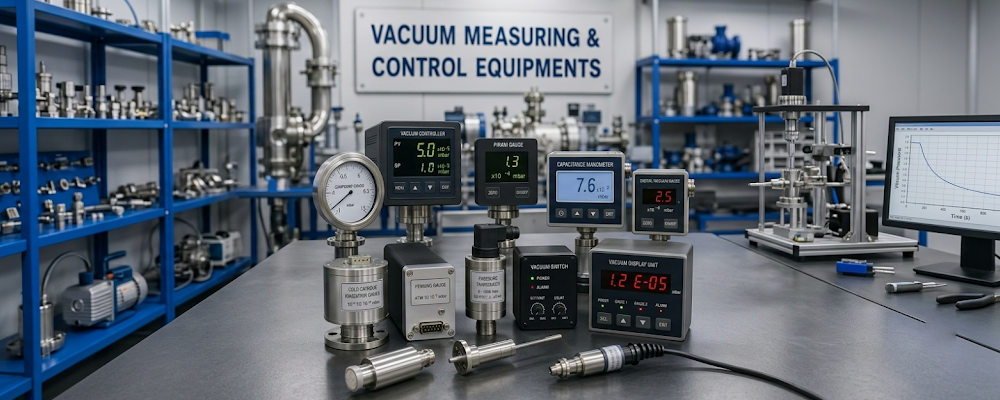
Vacuum measuring instruments play an important role in industrial processes where pressure control, system monitoring, and operational accuracy are essential. These instruments measure pressure levels below atmospheric pressure and help operators maintain the required vacuum conditions in different types of equipment. From manufacturing plants and laboratories to vacuum packaging systems and industrial processing units, reliable vacuum measurement supports consistent performance and process efficiency.
RK Engineering Services provides solutions for industrial measurement requirements, including vacuum measuring instruments such as Pirani gauges, pending gauges, full range gauges, and dial gauges. These instruments are used to monitor vacuum conditions, observe pressure variations, and support equipment operation across different industrial applications.
For businesses searching for vacuum measuring instrument manufacturers in India, understanding instrument types, measurement ranges, compatibility, and application requirements is essential when selecting a suitable product. The right vacuum measurement solution can help improve process monitoring, identify pressure fluctuations, and support routine maintenance.
What Is a Vacuum Measuring Instrument?
A vacuum measuring instrument is a device designed to measure pressure in a system operating below atmospheric pressure. It helps determine how much air or gas remains inside an enclosed chamber, pipeline, vessel, or vacuum processing system.
Unlike conventional pressure instruments that primarily measure positive pressure, vacuum measuring instruments are designed to monitor negative gauge pressure or absolute pressure at low-pressure conditions, depending on the instrument type.
Vacuum measurement is important because different industrial applications require different pressure levels. For example, a vacuum packaging system may require a different measurement range from a laboratory vacuum chamber or a high-vacuum industrial process.
Common functions of vacuum measuring instruments include:
-
Measuring vacuum pressure within a specified range.
-
Monitoring pressure changes during equipment operation.
-
Supporting vacuum system maintenance and troubleshooting.
-
Helping operators maintain the required process conditions.
-
Identifying unexpected pressure variations that may indicate leakage or equipment issues.
-
Supporting quality control and repeatable industrial operations.
RK Engineering Services can be considered for vacuum measurement requirements where the instrument specification, operating conditions, and application compatibility are carefully evaluated.
Why Are Vacuum Measuring Instruments Important in Industrial Applications?
Vacuum measuring instruments help industries maintain control over processes that depend on stable pressure conditions. Incorrect vacuum levels can affect product quality, process consistency, equipment performance, and operating efficiency.
The importance of these instruments extends across several industrial activities.
1. Accurate Pressure Monitoring
Vacuum gauges provide pressure readings that help operators determine whether a system is operating within its required limits. Accurate monitoring is particularly important in applications where even small pressure variations can influence the final result.
2. Improved Process Control
Manufacturing processes often require specific vacuum conditions. A suitable measuring instrument allows operators to observe pressure changes and take corrective action when readings move outside the desired operating range.
3. Maintenance and Troubleshooting
Unexpected pressure readings may indicate a leak, a deteriorating seal, a pump performance issue, or another system problem. Vacuum measurement helps maintenance personnel investigate these conditions before they lead to extended downtime.
4. Equipment Protection
Monitoring vacuum conditions can help prevent operation outside specified limits. When combined with suitable inspection and maintenance practices, vacuum gauges support dependable equipment operation.
5. Consistent Production Quality
In vacuum drying, packaging, coating, and other pressure-sensitive processes, stable vacuum conditions can contribute to more consistent production outcomes.
Types of Vacuum Measuring Instruments Offered for Industrial Requirements
Different vacuum measuring instruments use different measurement principles and provide different levels of information. The most suitable option depends on the required pressure range, process environment, accuracy, response time, and equipment compatibility.
1. Pirani Gauge
A Pirani gauge is a vacuum measuring instrument that uses the relationship between gas pressure and heat transfer to estimate pressure inside a vacuum system. It typically contains a heated sensing element whose heat loss changes as the surrounding gas pressure changes.
The instrument detects these changes and converts them into a pressure reading. Pirani gauges are commonly used for rough and medium vacuum measurement, subject to the particular model's specifications.
Key features and benefits:
-
Supports vacuum pressure monitoring over a defined measurement range.
-
Uses thermal conductivity principles to estimate gas pressure.
-
Can be integrated into compatible vacuum systems.
-
Supports routine monitoring in industrial and laboratory environments.
-
Provides useful pressure information for vacuum pump operation and process control.
Typical applications:
-
Vacuum coating equipment.
-
Laboratory vacuum systems.
-
Vacuum drying processes.
-
Industrial vacuum chambers.
-
Vacuum packaging machinery.
-
Research and development equipment.
When selecting a Pirani gauge, buyers should check its measurement range, gas-type dependence, connection dimensions, electrical interface, and operating temperature limits.
2. Pending Gauge
The term pending gauge is included here as specified in the product brief. However, it is not a widely standardized general name for a vacuum gauge, so the exact instrument type should be confirmed with the supplier before purchasing.
Depending on the intended product, the requirement may refer to a particular gauge design, a model-specific product name, or another vacuum measurement instrument.
Before selecting this gauge, industrial buyers should verify:
-
The exact product name and model number.
-
The measurement principle used by the instrument.
-
The supported vacuum pressure range.
-
The required display or output type.
-
The mounting arrangement and process connection.
-
Compatibility with the existing vacuum equipment.
Confirming these details helps ensure that the selected instrument meets the intended application requirements. Customers can share the existing instrument's photograph, model number, or technical datasheet with RK Engineering Services to help clarify the product specification.
3. Full Range Gauge
A full range gauge is designed to measure vacuum pressure across a broad range, depending on the specific technology and model. Some full-range vacuum instruments combine different sensing principles to cover pressure regions that a single sensor cannot measure effectively.
For example, certain instruments combine Pirani measurement with an additional sensor technology to support monitoring across a wider vacuum range. The actual measurement coverage depends on the product design.
Key advantages:
-
Supports monitoring over an extended pressure range when specified by the manufacturer.
-
Can reduce the need to use multiple separate gauges in compatible systems.
-
Helps operators observe changes as the vacuum system moves between operating conditions.
-
Can support vacuum process monitoring in industrial and laboratory environments.
-
May provide digital displays, electrical outputs, or control interfaces, depending on the model.
Applications include:
-
Vacuum processing systems.
-
Industrial research laboratories.
-
Vacuum furnaces.
-
Thin-film coating systems.
-
Semiconductor-related vacuum equipment.
-
Multi-stage vacuum pumping arrangements.
When choosing a full range gauge, confirm the minimum and maximum measurable pressure, accuracy across the range, sensor combination, calibration requirements, and compatibility with the vacuum controller.
4. Dial Gauges
Dial gauges provide readings through a mechanical pointer and a graduated dial. In vacuum applications, a suitable vacuum dial gauge indicates the pressure or vacuum level within the range for which it is designed.
The term can also refer to dial-type pressure gauges used in other industrial measurement applications. Therefore, it is important to confirm that the selected model is specifically suitable for the required vacuum service.
Important characteristics:
-
An analog dial display for direct visual readings.
-
A clearly marked scale when correctly selected for the application.
-
Straightforward observation during routine equipment inspections.
-
Availability in different sizes, connection configurations, and measurement ranges, depending on the model.
-
Suitability for applications where a local visual indication is sufficient.
Typical applications:
-
Industrial vacuum equipment.
-
Vacuum vessels and compatible process lines.
-
Vacuum packaging installations.
-
Maintenance and service operations.
-
Equipment requiring a local pressure indication.
Before ordering a dial gauge, check the scale units, vacuum range, dial diameter, mounting type, connection size, materials, and suitability for the process environment.
How to Choose the Right Vacuum Measuring Instrument
Selecting the correct vacuum measuring instrument requires an understanding of the equipment and the conditions under which it will operate. A gauge that works well in one pressure range may not provide suitable readings in another.
Consider the following factors when comparing vacuum measurement products.
1. Measurement Range
Determine the minimum and maximum pressure values that need to be measured. Rough vacuum applications and high-vacuum applications may require different sensing technologies.
2. Measurement Accuracy
Review the manufacturer's stated accuracy, repeatability, and operating conditions. The acceptable tolerance depends on the process and its monitoring requirements.
3. Measurement Principle
Pirani gauges use thermal conductivity principles, while other vacuum instruments may use mechanical, capacitance-based, or ionization-based methods. The required pressure range determines which technology is appropriate.
4. Display and Output
Choose between an analog dial, a digital display, or a gauge with an electrical output. Digital outputs may be useful when the reading must be connected to a controller or monitoring system.
5. Process Compatibility
Check the process gas, operating temperature, potential contamination, vibration, and connection requirements. Some measurement technologies are more sensitive to gas composition or environmental conditions than others.
6. Installation Requirements
Confirm the mounting position, fitting type, flange or thread dimensions, cable connections, and available installation space before placing an order.
7. Calibration and Maintenance
Review calibration intervals and maintenance requirements. Regular inspection and appropriate calibration help maintain measurement reliability over time.
Applications of Vacuum Measuring Instruments Across Industries
Vacuum measuring instruments support a broad range of industrial and scientific applications. The appropriate instrument depends on the pressure range and the measurement requirements of each process.
Manufacturing and Industrial Processing
Manufacturing facilities use vacuum measurement to monitor pressure in vacuum chambers, material handling equipment, and specialized production systems.
Vacuum Packaging
Packaging systems may use vacuum gauges to monitor pressure during air removal. Correct measurement helps operators maintain process consistency and verify that equipment is operating as expected.
Laboratories and Research Facilities
Research laboratories use vacuum measuring instruments in experimental chambers, analytical equipment, and other systems that require controlled low-pressure conditions.
Vacuum Coating
Vacuum coating processes depend on carefully controlled chamber conditions. Suitable gauges help operators monitor pressure during preparation and processing.
Vacuum Furnaces
Vacuum furnaces require pressure monitoring during heat treatment and other specialized thermal processes. Gauge selection should account for the required pressure range and the furnace's operating environment.
Pharmaceutical and Chemical Processing
Certain pharmaceutical and chemical processes use vacuum for drying, evaporation, and other operations. Suitable instruments help monitor pressure, provided the selected gauge is compatible with the process conditions.
Educational and Technical Institutions
Engineering colleges, technical training facilities, and research centers use vacuum measuring equipment for demonstrations, experiments, and equipment testing.
What Are the Benefits of Using a Properly Selected Vacuum Pump?
Choosing a vacuum measurement supplier involves more than comparing product names. Buyers should ensure that the instrument matches the actual process requirements and that the technical specifications are clearly understood.
RK Engineering Services is the company name associated with this vacuum measuring instrument content. Customers evaluating its solutions should confirm product availability, specifications, and application suitability directly with the company.
Important considerations when discussing your requirement include:
Product selection
Identify the appropriate gauge type for the intended vacuum range.
Technical specifications
Verify the measurement range, accuracy, display, and connection details.
Application compatibility
Confirm whether the instrument is suitable for the gases, temperatures, and operating conditions involved.
Installation requirements
Check dimensions, fittings, mounting arrangements, and electrical connections.
After-sales requirements
Ask about calibration support, maintenance guidance, warranty terms, and technical assistance where available.
These checks help businesses make informed purchasing decisions and select a vacuum measuring solution suited to their equipment.
Vacuum Measuring Instrument Manufacturers in India: What Should Buyers Check?
Businesses searching for vacuum measuring instrument manufacturers in India should evaluate suppliers according to technical suitability, product documentation, and support requirements rather than relying only on product descriptions.
The following checklist can help simplify the purchasing process:
-
Confirm the product category: Identify whether you need a Pirani gauge, full range gauge, vacuum dial gauge, or another instrument.
-
Define the pressure range: Specify the operating and required measurement limits.
-
Request technical documentation: Review the datasheet, model details, and applicable performance specifications.
-
Verify compatibility: Check process connections, output requirements, gas compatibility, and environmental limitations.
-
Discuss calibration: Understand the calibration procedure and recommended service interval.
-
Compare total operating requirements: Consider installation, maintenance, replacement, and integration needs.
-
Confirm supply and support: Ask the supplier about availability, delivery timelines, warranty, and technical assistance.
RK Engineering Services can be contacted to discuss the specific vacuum measurement requirements and confirm which products are suitable for the intended application.
Frequently Asked Questions
1. What is a vacuum measuring instrument used for?
A vacuum measuring instrument measures pressure below atmospheric pressure in equipment such as vacuum chambers, packaging machines, coating systems, laboratories, and industrial processing units. It helps operators monitor system conditions and identify pressure changes.
2. Which vacuum measuring instruments are commonly used in industry?
Common options include Pirani gauges, capacitance diaphragm gauges, mechanical vacuum gauges, full range gauges, and ionization gauges. The best choice depends on the required pressure range, measurement accuracy, process gas, and operating conditions.
3. What is a Pirani gauge, and how does it work?
A Pirani gauge estimates vacuum pressure by measuring changes in heat transfer from a heated sensing element to the surrounding gas. Because heat transfer varies with gas pressure, the instrument can convert the measured change into a pressure indication.
4. What is a full range vacuum gauge?
A full range vacuum gauge is designed to cover a broad pressure range. Some models combine different sensing technologies to measure pressure across multiple vacuum regions. The actual range and performance depend on the model.
5. What is a pending gauge?
“Pending gauge” is not a widely standardized name for a general vacuum instrument. Buyers should confirm the exact product designation, model number, and measurement specifications with the supplier before ordering.
6. Can dial gauges measure vacuum pressure?
Yes. Dial-type gauges designed and calibrated for vacuum service can indicate vacuum pressure through a mechanical pointer and graduated scale. Buyers should ensure that the selected model supports the required range and installation conditions.
7. How do I select the correct vacuum measuring instrument?
Start by identifying the required pressure range, measurement accuracy, process gas, operating temperature, connection type, display requirements, and electrical output needs. Compare these details with the manufacturer's technical datasheet before making a selection.
8. Are Pirani gauges suitable for high-vacuum measurement?
A standard Pirani gauge is generally used for rough and medium vacuum measurement, with the precise range determined by its design. Applications requiring lower pressures may need a different sensor or a combined-gauge arrangement.
9. Why is vacuum gauge calibration important?
Calibration helps establish whether an instrument's readings remain within the required measurement tolerance. It supports reliable monitoring, process consistency, and maintenance decisions.
10. Where can I inquire about vacuum measuring instruments in India?
You can contact RK Engineering Services to discuss the required gauge type, pressure range, application, and technical specifications. Confirm the available models, pricing, delivery, and support arrangements directly with the company.