Vacuum Components Manufacturers in India
Vacuum technology plays an important role in industries that require controlled pressure, clean processing environments, leak prevention, and reliable equipment performance. From research laboratories and industrial production units to specialized manufacturing facilities, vacuum systems depend on well-designed components to maintain operating conditions and support efficient processes. Choosing experienced vacuum components manufacturers in India helps businesses find suitable components for their equipment requirements, installation conditions, and maintenance needs.
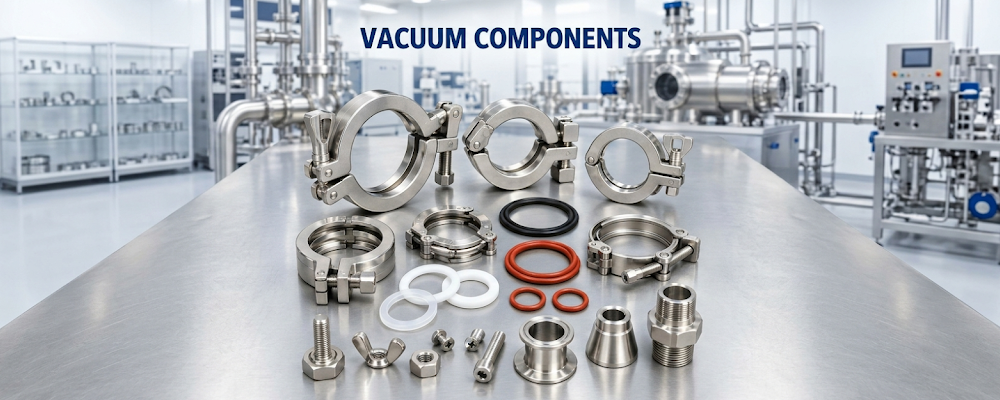
RK Engineering Services provides vacuum component solutions for industrial applications that require dependable sealing, reliable connections, inspection access, and fluid or electrical transfer through vacuum systems. Essential components include vacuum shaft seals, vacuum view ports, vacuum multi-pin electrical feedthroughs, water feedthroughs, flexible bellows, vacuum grease, pipelines, elbows, and O-rings.
Each component serves a specific purpose within a vacuum assembly. Selecting the right combination can help reduce leakage risks, simplify maintenance, support consistent operation, and improve the overall reliability of vacuum equipment. Businesses searching for vacuum components in India should consider material compatibility, operating pressure, temperature conditions, connection dimensions, and the intended application before making a purchasing decision.
What Are Vacuum Components and Why Are They Important?
Vacuum components are specialized parts used to create, maintain, connect, inspect, or control a vacuum environment. They help different sections of a vacuum system function together while limiting unwanted air entry and supporting the movement of mechanical, electrical, or fluid connections across system boundaries.
The performance of a vacuum system depends on more than the vacuum pump alone. Seals, feedthroughs, viewing windows, connecting pipes, and other accessories must be appropriate for the operating conditions.
Key functions of vacuum components include:
-
Leak prevention: Sealing components help limit unwanted gas entry and preserve the required vacuum level.
-
System connectivity: Pipelines, elbows, and flexible bellows connect equipment and accommodate specific installation requirements.
-
Process visibility: Vacuum view ports allow operators to observe activities inside a chamber without opening the system.
-
Electrical connectivity: Multi-pin electrical feedthroughs enable electrical signals or power connections to pass through a vacuum chamber wall.
-
Fluid transfer: Water feedthroughs support suitable fluid connections across equipment boundaries.
-
Equipment protection: Compatible grease, seals, and correctly selected fittings can help support smooth operation and reduce maintenance problems.
When these components are correctly specified, they can contribute to better system reliability, easier servicing, and more predictable industrial performance.
Which Vacuum Components Does RK Engineering Services Offer?
RK Engineering Services supports industrial vacuum component requirements across several essential product categories. The selection of each component should be based on the vacuum level, operating environment, material requirements, and equipment configuration.
1. Vacuum Shaft Seals
Vacuum shaft seals help control leakage around rotating or moving shafts that pass through a vacuum system boundary. They are important in equipment where a mechanical drive must operate while maintaining the required pressure conditions.
A suitable shaft seal can help prevent unwanted air ingress, limit the escape of process gases, and protect connected equipment from contamination. Seal selection depends on shaft speed, surface finish, temperature, pressure difference, lubrication requirements, and the nature of the surrounding medium.
Common applications include:
-
Vacuum pumps and rotating machinery.
-
Industrial vacuum processing equipment.
-
Specialized mechanical assemblies.
-
Equipment requiring a sealed shaft connection.
RK Engineering Services can assist buyers in identifying shaft seal requirements based on the intended equipment and operating conditions.
2. Vacuum View Ports
Vacuum view ports provide a viewing window into a vacuum chamber or enclosed process area. They allow operators and technicians to observe internal conditions while maintaining the chamber's sealed environment.
View ports are useful when direct observation is required during testing, processing, inspection, or research. Their construction must be suitable for the pressure differential, temperature range, mounting arrangement, and any exposure to process chemicals or cleaning agents.
Important selection factors include:
-
Window material and optical clarity.
-
Required viewing diameter.
-
Vacuum pressure and temperature conditions.
-
Mounting dimensions and sealing arrangement.
-
Resistance to the process environment.
A properly specified vacuum view port supports safe observation and convenient monitoring without repeatedly opening the vacuum chamber.
3. Vacuum Multi-Pin Electrical Feedthroughs
Vacuum multi-pin electrical feedthroughs allow multiple electrical conductors to pass through a vacuum chamber wall while preserving the necessary seal. They are useful in systems that require connections for sensors, measurement instruments, control circuits, or internal electrical equipment.
These feedthroughs help connect internal devices with external control or monitoring systems. Their design must account for the number of pins, electrical ratings, insulation, connector configuration, temperature, and vacuum requirements.
Typical applications include:
-
Vacuum testing and measurement equipment.
-
Laboratory and research chambers.
-
Industrial process monitoring systems.
-
Electrical connections for equipment installed inside vacuum enclosures.
Selecting the correct feedthrough helps support dependable electrical communication while maintaining the integrity of the vacuum boundary.
4. Water Feedthroughs
Water feedthroughs are used when a suitable water or cooling-fluid connection must pass through a chamber wall or equipment boundary. Depending on the design, they can support cooling circuits and other applications requiring fluid transfer into or out of a vacuum assembly.
The feedthrough must be selected according to the required flow rate, fluid compatibility, pressure, temperature, connection type, and vacuum conditions. Particular attention should be given to the separation between the fluid path and the vacuum space.
Potential applications include:
-
Cooling arrangements for vacuum equipment.
-
Industrial testing systems.
-
Specialized research and laboratory installations.
-
Equipment requiring a fluid connection through an enclosure.
Correct specification helps reduce the risk of leakage, contamination, and unwanted interaction between the fluid circuit and the vacuum environment.
5. Flexible Bellows
Flexible bellows provide a degree of movement or flexibility between connected sections of a vacuum system. They can help accommodate alignment differences, thermal expansion, vibration, and limited mechanical displacement, depending on their design.
Bellows are commonly considered where rigid piping could transmit unwanted forces or where the equipment layout requires a flexible connection. Material, length, diameter, pressure rating, movement allowance, and fatigue life are important selection factors.
Key benefits include:
-
Accommodating specified movement between connections.
-
Helping isolate certain vibration effects when properly designed.
-
Supporting flexible equipment arrangements.
-
Reducing mechanical stress caused by minor alignment changes.
The correct bellows configuration should be chosen for the actual pressure conditions and expected movement. Not every flexible bellows design is suitable for every vacuum level or application.
6. Vacuum Grease
Vacuum grease is a specialized lubricant or sealing aid used in compatible vacuum equipment and connections. Depending on the formulation and application, it may help lubricate suitable joints, assist assembly, or improve sealing at approved interfaces.
Not all greases are appropriate for vacuum environments. Some formulations can release volatile substances, contaminate sensitive processes, or degrade when exposed to elevated temperatures or incompatible chemicals.
When selecting vacuum grease, consider:
-
Vapour pressure and outgassing characteristics.
-
Operating temperature range.
-
Compatibility with seal materials and equipment surfaces.
-
Chemical exposure and cleanliness requirements.
-
Whether the component manufacturer permits grease use.
Using the correct formulation and applying it only where appropriate can help maintain equipment performance and avoid contamination problems.
7. Vacuum Pipelines
Vacuum pipelines connect pumps, chambers, valves, and other equipment to form a continuous vacuum flow path. Their dimensions, material, internal surface condition, and joint design can influence conductance, cleanliness, and overall system performance.
Pipeline selection should account for the required flow capacity, system pressure, material compatibility, installation space, and connection standards. Poorly selected pipe dimensions or unsuitable joints can restrict flow or introduce potential leak points.
Common considerations include:
-
Pipe diameter and required flow conductance.
-
Material and corrosion resistance.
-
Connection type and sealing method.
-
Cleanliness and internal surface finish.
-
Mechanical support and installation alignment.
Well-planned vacuum pipelines help connect system components efficiently and make future inspection or maintenance more manageable.
8. Vacuum Elbows
Vacuum elbows change the direction of a pipeline or vacuum connection to accommodate the layout of the equipment. They are available in different angles, sizes, materials, and connection configurations, depending on the application.
The elbow's geometry can influence flow resistance and conductance. For systems requiring high pumping speeds, selecting an appropriate bend radius and internal diameter can be especially important.
Vacuum elbows are useful for:
-
Connecting pipes installed at different angles.
-
Working around space limitations.
-
Organizing vacuum chamber and pump layouts.
-
Creating practical, maintainable piping arrangements.
Choosing compatible elbows and suitable sealing connections helps create a properly integrated vacuum line.
9. Vacuum O-Rings
O-rings are circular sealing elements used to prevent leakage between mating surfaces. In vacuum systems, they are commonly installed in grooves on flanges, covers, access panels, and other suitable connections.
Their effectiveness depends on the elastomer material, groove dimensions, surface finish, compression, temperature, and chemical exposure. Different O-ring materials have different limits for gas permeability, outgassing, and compatibility with process conditions.
Important selection factors include:
-
Inner diameter and cross-sectional size.
-
Elastomer material and hardness.
-
Static or dynamic sealing requirements.
-
Temperature and chemical compatibility.
-
Required vacuum level and acceptable leakage rate.
Correctly sized and installed O-rings can help maintain reliable seals and simplify component replacement during routine servicing.
How to Choose the Right Vacuum Components Manufacturer in India
Selecting a vacuum component supplier involves evaluating technical suitability as well as purchasing and service requirements. A component that fits physically may still be unsuitable if its materials, sealing arrangement, or pressure rating do not match the intended application.
Consider the following points before selecting a manufacturer or supplier:
-
Understand the application: Identify whether the components are intended for a vacuum pump, processing chamber, research system, or other equipment.
-
Confirm operating conditions: Specify the required vacuum level, pressure differential, temperature, and expected movement.
-
Check material compatibility: Ensure that metals, elastomers, window materials, and lubricants suit the process environment.
-
Verify dimensions and connections: Confirm pipe sizes, flange patterns, thread types, shaft dimensions, and feedthrough configurations.
-
Evaluate sealing performance: Ask about suitable seal designs, expected leakage performance, and testing documentation where applicable.
-
Review quality requirements: Check product specifications, inspection procedures, traceability, and relevant certifications when required.
-
Consider maintenance: Select components that can be inspected, cleaned, and replaced without unnecessary downtime.
-
Request technical clarification: Share drawings, photographs, equipment details, and operating parameters to help establish the correct specification.
RK Engineering Services can be considered for vacuum component requirements where buyers need to identify suitable parts for their equipment and applications. Product availability, customization, material options, and technical specifications should be confirmed directly before ordering.
What Industries Use Vacuum Components?
Vacuum components are used across industries that depend on controlled pressure, specialized processing, testing, or contamination management. The required component specifications vary according to the equipment and operating environment.
Major application areas include:
Pharmaceutical and Chemical Industries
Vacuum equipment supports selected processing, drying, filtration, and material-handling operations.
Research and Testing Laboratories
Vacuum chambers, electrical feedthroughs, and view ports support experiments and equipment testing.
Automotive and Engineering Industries
Vacuum pumps, shaft seals, pipelines, and fittings are used in suitable manufacturing and testing systems.
Electronics and Semiconductor Manufacturing
Specialized vacuum connections and feedthroughs support processes that require controlled environments.
Industrial Machinery Manufacturing
Seals, O-rings, flexible bellows, and pipe fittings help connect and maintain vacuum equipment.
Scientific and Analytical Equipment
Vacuum view ports, electrical feedthroughs, and compatible sealing materials support selected measurement and analytical systems.
The right component depends on the application, process requirements, and equipment design. Businesses should confirm that each selected component is suitable for its intended service conditions.
Why Consider RK Engineering Services for Vacuum Components?
When searching for vacuum components manufacturers in India, industrial buyers need a supplier who understands the importance of component compatibility, dimensions, sealing requirements, and application-specific selection.
RK Engineering Services serves as a point of contact for businesses looking for vacuum component solutions, including sealing products, feedthroughs, flexible connections, pipelines, and related accessories.
Reasons to consider RK Engineering Services for your requirements include:
-
Multiple component categories: Find information about vacuum shaft seals, view ports, feedthroughs, bellows, grease, pipelines, elbows, and O-rings through one supplier contact.
-
Application-focused selection: Discuss the operating environment and equipment configuration before choosing components.
-
Technical specification matching: Use equipment drawings, measurements, and operating details to identify appropriate product requirements.
-
Industrial application support: Explore component options for vacuum equipment, laboratory systems, and industrial installations.
-
Maintenance and replacement needs: Identify replacement components based on existing dimensions, materials, and connection configurations.
Specific product availability, manufacturing capabilities, customization options, certifications, and delivery schedules should be confirmed with RK Engineering Services before placing an order.
How Can You Request Vacuum Components from RK Engineering Services?
Finding the correct vacuum component begins with providing clear technical information. This helps reduce specification errors and makes it easier to determine whether a component is suitable for the intended installation.
Follow these steps when enquiring about vacuum components:
-
Identify the component: Specify whether you need a vacuum shaft seal, vacuum view port, multi-pin electrical feedthrough, water feedthrough, flexible bellows, vacuum grease, pipeline, elbow, or O-ring.
-
Share the equipment details: Provide the equipment make and model, if available, along with the existing component's part number.
-
Provide dimensions: Include diameters, lengths, flange sizes, thread specifications, and connection details as applicable.
-
Explain the operating conditions: Mention the required vacuum level, temperature, fluid exposure, shaft speed, or electrical ratings where relevant.
-
Attach supporting information: Technical drawings, photographs, and product datasheets can help clarify the requirement.
-
Confirm the specification: Review material compatibility, dimensions, performance requirements, pricing, and delivery timelines before finalizing the purchase.
This process helps buyers make informed decisions and select components that match their vacuum system requirements.
Frequently Asked Questions
1. Who are vacuum components manufacturers in India?
Vacuum components manufacturers and suppliers provide parts used to build, seal, connect, inspect, and maintain vacuum systems. These products can include shaft seals, view ports, electrical feedthroughs, water feedthroughs, flexible bellows, pipelines, elbows, O-rings, and vacuum-compatible grease. RK Engineering Services is a contact for enquiries about these vacuum component categories.
2. What are the main components used in a vacuum system?
The main components depend on the system design. Common examples include vacuum pumps, valves, pipelines, flanges, shaft seals, O-rings, view ports, electrical feedthroughs, and flexible bellows. Specialized installations may also require water feedthroughs and vacuum-compatible lubricants.
3. What is the purpose of a vacuum shaft seal?
A vacuum shaft seal helps prevent unwanted gas leakage around a shaft that passes through a vacuum boundary. Its suitability depends on the shaft's movement, speed, temperature, pressure difference, and surrounding environment.
4. Why are vacuum view ports required?
Vacuum view ports allow operators to observe processes inside an enclosed vacuum chamber without opening it. The selected window and mounting arrangement must withstand the specified pressure differential and operating temperature.
5. What is a vacuum multi-pin electrical feedthrough?
A vacuum multi-pin electrical feedthrough provides multiple electrical connections through a chamber wall while maintaining the required seal. It is commonly used for sensors, measurement devices, controls, and other electrical equipment installed inside vacuum enclosures.
6. What is the difference between water feedthroughs and electrical feedthroughs?
Water feedthroughs provide a suitable fluid connection through an equipment boundary, whereas electrical feedthroughs allow electrical conductors to pass through that boundary. Both must be selected according to their respective operating conditions and sealing requirements.
7. How do flexible bellows help vacuum systems?
Flexible bellows accommodate specified movement between connected components. Depending on their design, they can help manage alignment differences, thermal expansion, and vibration-related mechanical effects. Their pressure rating and movement limits must match the application.
8. Which grease is suitable for vacuum applications?
Suitable vacuum grease depends on the required vacuum level, operating temperature, materials, and contamination limits. Low-outgassing characteristics and compatibility with the application are important considerations. The equipment or seal manufacturer's recommendations should be followed.
9. Why are O-rings important in vacuum equipment?
O-rings create seals between compatible mating surfaces, helping prevent gas leakage. Correct material selection, groove dimensions, compression, and surface condition are essential for reliable performance.
10. How should vacuum pipelines and elbows be selected?
Vacuum pipelines and elbows should be selected based on the required flow conductance, internal diameter, material, pressure conditions, installation layout, and connection type. Correct sizing and suitable joints help reduce unnecessary flow restrictions and leakage risks.