Vacuum Coating Unit Manufacturers in India
Vacuum coating technology plays an important role in modern manufacturing by helping industries apply thin, uniform layers of metal or other coating materials to different surfaces. These coatings can improve appearance, surface performance, electrical properties, reflectivity, and resistance to environmental exposure, depending on the coating material and application. As industrial requirements continue to evolve, manufacturers are looking for reliable vacuum coating equipment, compatible components, and efficient coating processes.
RK Engineering Services provides solutions for businesses looking for vacuum coating unit manufacturers in India, along with vacuum coating equipment, deposition systems, coating consumables, and essential accessories. Selecting the right vacuum coating system depends on several factors, including the substrate material, coating thickness, production capacity, required film properties, and operating conditions.
From thermal evaporation systems and electron beam (E-beam) systems to sputtering equipment and vacuum metallising units, understanding the available technologies helps businesses identify suitable solutions for their manufacturing requirements.
What Is a Vacuum Coating Unit?
A vacuum coating unit is an industrial system that deposits a thin layer of material onto a substrate inside a controlled low-pressure environment. The process reduces interference from atmospheric gases and supports the formation of coatings with specific physical, optical, or functional characteristics.
Vacuum coating technology is used in applications involving metals, glass, plastics, optical components, electronic parts, decorative products, and specialised industrial materials.
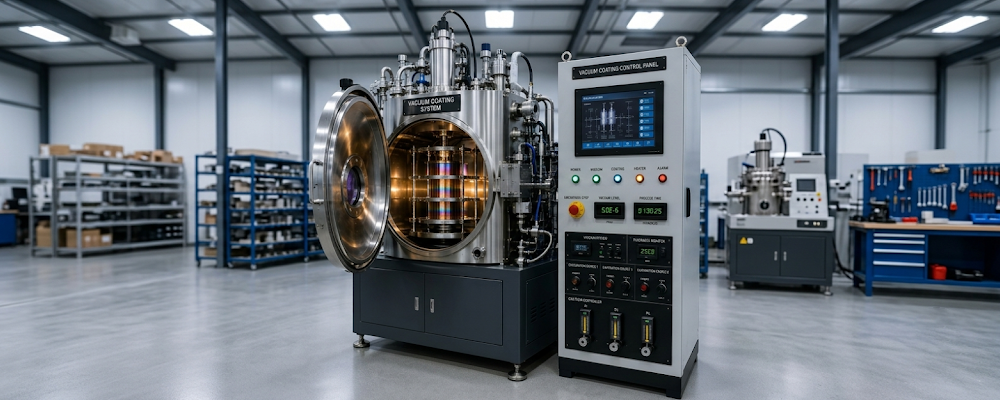
A typical vacuum coating unit may include the following components:
-
Vacuum chamber: Provides an enclosed environment for the coating process.
-
Vacuum pumping system: Removes air and helps achieve the required operating pressure.
-
Deposition source: Generates or releases the coating material through evaporation or sputtering.
-
Substrate holder: Positions the components that need to be coated.
-
Thickness monitor and controller: Measures deposited film thickness and helps control the deposition process.
-
Power supply: Provides the electrical power required by the selected deposition technology.
-
Process control system: Supports the management of operating parameters and repeatability.
The configuration of each system depends on its intended application, the materials being deposited, and the required production output.
Why Choose RK Engineering Services for Vacuum Coating Equipment?
When searching for vacuum coating unit manufacturers in India, businesses should evaluate technical suitability, component compatibility, process requirements, and ongoing equipment support. RK Engineering Services caters to requirements related to vacuum coating systems and associated components.
The right equipment configuration can help manufacturers establish a coating process that meets their product specifications and production objectives.
Key Considerations When Selecting a Supplier
-
Application requirements: Identify whether the coating is intended for decorative, optical, electronic, reflective, or functional purposes.
-
Deposition technology: Choose between thermal evaporation, E-beam evaporation, and sputtering according to the material and desired film properties.
-
Equipment configuration: Evaluate chamber size, pumping capacity, deposition sources, substrate fixtures, and process controls.
-
Component availability: Consider the availability of coating materials, sputtering targets, quartz crystals, liners, and evaporation accessories.
-
Process monitoring: Ensure that suitable thickness monitors, controllers, and measurement methods are available.
-
Maintenance requirements: Review access to consumables, replacement components, and technical assistance.
RK Engineering Services can be considered when evaluating vacuum coating equipment and related supplies for industrial applications. Customers should confirm the required specifications, equipment configuration, and available services before finalising a purchase.
What Are the Different Types of Vacuum Coating Systems?
Different vacuum deposition technologies serve different material and application requirements. The following systems are commonly considered when selecting industrial vacuum coating equipment.
1. Thermal Evaporation Systems
Thermal evaporation is a physical vapour deposition (PVD) process in which a coating material is heated inside a vacuum chamber until it evaporates. The resulting vapour travels through the chamber and condenses on the substrate, creating a thin coating.
Thermal evaporation systems are used when a material can be evaporated effectively under suitable process conditions.
Important features and considerations include:
-
Heating elements designed for the selected coating material.
-
Compatible evaporation boats, baskets, or filaments.
-
Appropriate power supplies and temperature control arrangements.
-
Vacuum levels suitable for the intended deposition process.
-
Substrate positioning and coating thickness monitoring.
Applications: Decorative metallisation, reflective surfaces, selected optical coatings, thin-film research, and electronic applications.
Thermal evaporation systems are often considered for applications that require a relatively straightforward evaporation process and suitable deposition rates. Material compatibility and uniformity requirements should be assessed before selecting a system.
2. E-Beam Systems
Electron beam evaporation, commonly known as E-beam evaporation, uses a focused beam of electrons to heat and evaporate a coating material. The material is typically held in a water-cooled crucible, allowing the source to operate at high temperatures without heating the entire crucible assembly to the same degree.
E-beam systems can process materials with high melting points that may be difficult to deposit using conventional thermal evaporation arrangements.
Key characteristics include:
-
Electron beam generation and beam-control components.
-
Suitable crucibles and material-holding arrangements.
-
High-vacuum pumping and process monitoring.
-
Power supplies designed for the electron beam source.
-
Deposition controls for managing coating thickness and process conditions.
Applications: Optical coatings, specialised electronic films, research laboratories, advanced materials, and selected semiconductor-related processes.
The choice of an E-beam system depends on the evaporation characteristics of the material, coating uniformity, substrate geometry, and production requirements.
3. Sputtering Systems
Sputtering is a vacuum deposition process in which energetic ions, commonly generated in a plasma, strike a target material and dislodge atoms from its surface. These atoms travel through the chamber and form a coating on the substrate.
Sputtering systems are suitable for many metals, alloys, and compound materials, depending on the target, process gas, and system configuration.
Common sputtering configurations include:
-
DC sputtering: Often used for electrically conductive targets.
-
RF sputtering: Frequently used for insulating materials and selected specialised targets.
-
Magnetron sputtering: Uses magnetic fields to help sustain the plasma and improve deposition efficiency.
-
Reactive sputtering: Introduces a reactive gas to form compounds such as oxides or nitrides.
Applications: Functional coatings, optical films, electronic components, decorative surfaces, wear-resistant layers, and research applications.
When choosing a sputtering system, manufacturers should consider target dimensions, material composition, power requirements, process gases, substrate movement, and the desired film characteristics.
4. Vacuum Metallising Units
Vacuum metallising units are designed to deposit thin metallic layers onto suitable surfaces under vacuum conditions. They are frequently associated with decorative and reflective coatings on products made from plastics, glass, and other compatible substrates.
A vacuum metallising system may include a vacuum chamber, pumping equipment, evaporation source, substrate fixtures, electrical controls, and film-thickness monitoring equipment.
Common applications include:
-
Decorative finishes on consumer products.
-
Reflective coatings for selected components.
-
Metallised packaging materials.
-
Automotive and household product components.
-
Selected plastic and glass products requiring metallic appearances.
The final coating quality depends on substrate preparation, material selection, surface geometry, process parameters, and the suitability of any required primer or protective topcoat.
Businesses evaluating vacuum metallising units should define their component dimensions, required finish, production volume, and coating material before selecting the equipment configuration.
Which Coating Materials Are Used in Vacuum Deposition?
Coating material selection directly affects the physical, optical, electrical, and chemical characteristics of the deposited film. The appropriate material depends on the substrate, deposition technique, operating environment, and performance objectives.
Commonly used vacuum deposition materials include:
-
Aluminium: Used in reflective and decorative coatings.
-
Gold: Selected for specific electrical, optical, and specialised applications.
-
Silver: Used where high reflectivity or particular electrical characteristics are required.
-
Copper: Applied in selected conductive and functional coating processes.
-
Chromium: Used in certain decorative and functional coating applications.
-
Nickel: Suitable for selected metallic and functional films.
-
Titanium: Used in specialised coatings and as a material for compound-film processes.
-
Silicon dioxide: Used in selected optical and insulating film applications.
-
Other oxides, nitrides, and specialised compounds: Selected according to the required coating performance and deposition process.
Not every material is compatible with every deposition source. Melting point, vapour pressure, chemical composition, target conductivity, and process temperature must be considered before selecting a material.
What Are Sputtering Targets and Why Are They Important?
Sputtering targets are solid materials used as the source of deposited atoms in a sputtering system. During operation, energetic ions bombard the target surface, releasing atoms that can form a thin film on a substrate.
The quality and composition of the target influence deposition behaviour and the characteristics of the resulting coating.
Types of Sputtering Targets
Depending on process requirements, targets may be available in materials such as:
-
Aluminium and copper.
-
Gold, silver, and other selected metals.
-
Titanium, chromium, and nickel.
-
Silicon and selected semiconductor materials.
-
Ceramic compounds and specialised alloys.
When sourcing sputtering targets, manufacturers should verify material purity, composition, dimensions, bonding requirements, target backing plates, and compatibility with the sputtering equipment.
Correct target selection helps support process consistency and reduces the risk of material-related deposition problems.
Why Are Quartz Crystals Used in Vacuum Coating Systems?
Quartz crystals are widely used in thin-film deposition monitoring systems. A quartz crystal microbalance measures changes in the oscillation frequency of a crystal as material accumulates on its surface. The instrument uses this measurement, together with appropriate calibration and tooling factors, to estimate deposited film thickness and deposition rate.
Quartz crystals are consumable components that need to be selected according to the monitoring instrument and deposition environment.
Important considerations include:
-
Crystal frequency and compatibility with the monitor.
-
Crystal dimensions and mounting arrangement.
-
Material compatibility and operating temperature.
-
Replacement intervals based on process conditions.
-
Calibration and tooling-factor settings.
Using compatible quartz crystals helps maintain reliable thickness measurements and supports repeatable coating operations.
Thickness Monitors and Controllers for Accurate Film Deposition
Thickness monitors and controllers help operators track coating thickness and manage deposition processes. Depending on the equipment, the system may display deposition rate, accumulated thickness, and process-related measurements.
Some controllers can also regulate deposition-source output using feedback from the monitoring system.
Benefits of Thickness Monitoring
-
Helps achieve the specified coating thickness.
-
Supports repeatability across production batches.
-
Provides information about deposition rate.
-
Helps reduce unnecessary material consumption.
-
Supports quality checks and process documentation.
The appropriate monitor depends on whether the system uses quartz-crystal monitoring, optical monitoring, or another measurement method. Operators should also consider sensor placement, calibration, material density settings, and the geometry of the coating chamber.
Vacuum Coating Consumables and Essential Accessories
In addition to the main deposition equipment, vacuum coating processes require compatible consumables and replacement parts. Choosing suitable components can help maintain stable operation and reduce avoidable interruptions.
1. Liners
Liners are used in selected evaporation-source assemblies to contain coating materials and protect compatible source components from direct material contact. Their material and shape depend on the source design, operating temperature, and deposited material.
2. Evaporation Boats and Baskets
Evaporation boats and baskets hold coating materials while electrical heating brings them to the required evaporation conditions. They are available in different designs and materials according to the deposition source and process.
Correct selection depends on electrical resistance, operating temperature, material compatibility, and the quantity of coating material being evaporated.
3. Evaporation Filaments
Evaporation filaments act as heating elements in suitable thermal evaporation arrangements. They may be manufactured in different shapes and materials to support specific evaporation requirements.
The filament design should match the source assembly, electrical characteristics, and material being deposited.
4. Power Supplies
Power supplies provide the electrical energy required by evaporation sources, electron beam assemblies, sputtering cathodes, and other equipment components.
The appropriate power supply depends on the technology used, output requirements, control functions, and electrical compatibility. E-beam systems and sputtering systems generally require different power arrangements.
5. Coating Materials and Replacement Components
Regular access to suitable coating materials and compatible components helps manufacturers plan maintenance and production schedules. Before ordering, buyers should confirm part numbers, dimensions, material grades, equipment compatibility, and expected operating conditions.
RK Engineering Services can be contacted to discuss requirements for vacuum coating equipment, deposition consumables, and related components, subject to product availability and technical suitability.
Which Industries Use Vacuum Coating Units in India?
Vacuum coating equipment supports a broad range of manufacturing and research activities. The exact technology depends on the intended product, coating composition, and performance requirements.
Major Application Areas
Electronics
Selected conductive layers, functional films, and electronic component coatings.
Optics
Reflective and other specialised thin films on compatible optical substrates.
Automotive
Decorative and selected functional coatings for interior and exterior components.
Packaging
Metallic finishes and reflective layers on suitable packaging materials.
Consumer Products
Decorative coatings for selected plastic, glass, and metal products.
Research and Development
Experimental thin-film deposition and advanced materials research.
Industrial Manufacturing
Specialised surface treatments and functional coatings.
Not every vacuum coating technology is suitable for all these applications. Manufacturers should evaluate substrate compatibility, adhesion, coating uniformity, environmental requirements, and any applicable product standards before implementation.
How to Select the Right Vacuum Coating Unit Manufacturer in India
Choosing a suitable supplier involves more than comparing equipment prices. Businesses should understand their process requirements and verify whether the proposed equipment and accessories can support the intended application.
Consider the following checklist:
-
Define the coating objective: Specify whether the requirement is decorative, reflective, optical, conductive, or functional.
-
Identify the substrate: Confirm whether the components are made from plastic, glass, metal, ceramic, or another material.
-
Select the deposition method: Compare thermal evaporation, E-beam evaporation, and sputtering according to the material and required film properties.
-
Determine production capacity: Estimate batch size, component dimensions, cycle time, and expected output.
-
Specify coating thickness: Define the target thickness and the measurement method required for quality control.
-
Check system compatibility: Confirm that power supplies, deposition sources, monitors, and consumables work with the proposed configuration.
-
Evaluate maintenance needs: Consider the replacement of quartz crystals, liners, filaments, and other consumables.
-
Review technical documentation: Request equipment specifications, operating requirements, installation details, and warranty information where applicable.
-
Compare total operating costs: Include energy use, consumables, maintenance, process development, and production downtime.
-
Confirm supplier capabilities: Verify the manufacturer's or supplier's actual product range, technical support, delivery terms, and service commitments.
This approach helps buyers make informed purchasing decisions and select equipment that fits their operational needs.
Why Is Vacuum Coating Technology Important for Modern Manufacturing?
Vacuum coating technology enables manufacturers to create controlled thin films for products requiring specific surface characteristics. Depending on the application, a coating may improve reflectivity, provide a decorative appearance, support electrical functionality, or contribute to a specialised surface-performance requirement.
Important advantages can include:
-
Controlled film formation: Deposition parameters can be adjusted to achieve defined coating characteristics.
-
Material flexibility: Different metals and compounds can be deposited using suitable processes.
-
Application versatility: Vacuum coating serves industries ranging from packaging and consumer goods to optics and electronics.
-
Process monitoring: Thickness monitors and controllers support process measurement and repeatability.
-
Customisable configurations: Equipment can be configured around substrate dimensions, production capacity, and coating objectives.
Actual performance depends on system design, material compatibility, substrate preparation, operating conditions, and quality-control procedures.
Frequently Asked Questions
1. What does a vacuum coating unit manufacturer do?
A vacuum coating unit manufacturer designs or supplies equipment used to deposit thin layers of materials onto substrates inside a controlled vacuum environment. Depending on its capabilities, a supplier may also provide deposition sources, monitoring equipment, power supplies, consumables, and related accessories.
2. What types of vacuum coating systems are available?
Common types include thermal evaporation systems, electron beam evaporation systems, sputtering systems, and vacuum metallising units. Each technology has different operating characteristics and material compatibility requirements.
3. What is the difference between thermal evaporation and E-beam evaporation?
Thermal evaporation heats a material using a suitable resistive heating source, such as a boat or filament. E-beam evaporation uses a focused electron beam to heat the material. E-beam technology can be suitable for materials with higher melting points, subject to process requirements.
4. What is a sputtering system used for?
A sputtering system deposits thin films by releasing atoms from a target through energetic ion bombardment. It is used for selected metallic, compound, optical, electronic, and functional coatings.
5. What are sputtering targets made of?
Sputtering targets may be made from metals, alloys, semiconductors, and ceramic compounds. The material depends on the desired film composition and the requirements of the deposition process.
6. Why are quartz crystals required in vacuum coating equipment?
Quartz crystals act as sensing elements in compatible thickness-monitoring systems. Changes in crystal oscillation frequency help the instrument estimate deposited film thickness and deposition rate.
7. What is the function of a thickness monitor and controller?
A thickness monitor measures deposition-related parameters, while a controller can display measurements and, in suitable configurations, regulate the deposition process. These instruments help maintain the required film thickness and support repeatable production.
8. What are evaporation boats, baskets, and filaments used for?
These components support thermal evaporation processes. Boats and baskets hold coating materials, while filaments provide heating in compatible source designs. Their selection depends on the source configuration and the material being evaporated.
9. Which factors affect the cost of a vacuum coating unit in India?
Equipment cost depends on chamber dimensions, pumping capacity, deposition technology, automation, power requirements, monitoring systems, substrate fixtures, and production capacity. Installation, maintenance, and consumable costs should also be considered when comparing quotations.
10. How can I choose the right vacuum coating unit for my business?
Start by identifying the substrate, coating material, required film thickness, product dimensions, and production volume. Then compare compatible deposition technologies, monitoring options, maintenance requirements, and supplier support.
11. Does RK Engineering Services provide vacuum coating equipment and consumables?
RK Engineering Services is the company to contact for enquiries about vacuum coating equipment and related requirements. Buyers should directly confirm the current product range, availability of individual components, technical specifications, and applicable support services.
12. Can vacuum coating units be used for plastic and glass products?
Yes. Suitable vacuum coating technologies can be used for compatible plastic and glass substrates. The process may require appropriate surface preparation, fixtures, material selection, and additional protective layers depending on the product and intended use.